
Where RCC Releases Go
Crittenden Restricted Custody Center is associated with the county detention center in Marion. The elected Crittenden County jailer operates it, but it is not the 133-bed secure component. KDOC reports the RCC separately as a 39-bed restricted-custody unit for eligible male prisoners. That detail controls where a release inquiry should start. The sheriff keeps sheriff arrest and incident records, while the jailer normally holds the detention booking and release entry. A court order belongs with the Crittenden Circuit Court Clerk.
Leaving the secure jail can have several meanings. A local detainee may return to the community after bond, dismissal, time served, probation, or another valid order. A state prisoner may move into Kentucky Department of Corrections custody or leave under state authority. A person held for another county or a federal authority may be handed to that custodian. A roster departure alone cannot tell these paths apart.
| Observed event | Best confirming record |
|---|---|
| Name no longer on JailTracker | Jail booking/release sheet |
| Release ordered in local case | District or Circuit Court file |
| State sentence or DOC number | KOOL profile and KDOC Daily Releases |
| Transfer to another authority | Release destination and receiving record |
“Released to other agency” means the person remained in government custody at the handoff. It does not mean a return to the community.
Confirm a Crittenden RCC Release
The official detention-center inmate page sends visitors to the exact Crittenden County JailTracker tenant. That live list is useful for a first check. It is not a historical release archive, and the lack of a public history tab does not mean that release fields are absent from the jail's internal record.
- Search the official inmate page with the person's name. Compare identifiers before relying on a match.
- If the name is gone, call the detention center and ask whether custody ended or another agency received the person.
- Request the existing booking/release sheet. Ask for date and time, disposition or type, and receiving destination if transferred.
- Check the local court file for the legal basis. A bond, dismissal, sentence, or probation order may explain the jail event.
- If a DOC or PID number exists, compare the Kentucky Online Offender Lookup and KDOC Daily Releases.
A court order or accepted bond can start release processing. Neither proves that physical release is complete when another hold, identity check, or transfer remains.
The broader Crittenden County release search explains how the jail, court, VINE, state, and federal paths fit together. Use the source that matches the custody authority.
Detention Center Records and Contact
Ask the jail for an existing record rather than requesting a new narrative. A focused request gives the full name, an approximate booking date, and the fields sought. The official directory identifies Jailer Athena Hayes. Email is listed, but no published detention-center policy guarantees that email alone is an accepted filing channel, so confirm the delivery method first.
Crittenden Restricted Custody Center208 W. Carlisle Street
Marion, KY 42064
270-965-3185
athena.hayes@crittendencountyky.org
A useful request asks for the booking/release sheet and any existing field showing booking number, admission date and time, release date and time, release type, and receiving agency or destination. If the record uses a code, ask for an existing code legend. Kentucky agencies need only produce records they already keep.
Do not route a jail release request to the sheriff merely because the sheriff made the arrest. Request sheriff incident material from the sheriff, judicial orders from the clerk, and detention release data from the jailer. Sealed, expunged, juvenile, investigatory, private, or security-sensitive material may be withheld or redacted.
About Restricted Community Custody
KDOC weekly jail reporting separates 133 secure beds from the 39-bed Restricted Custody Center. The figures describe distinct custody components. They should not be combined into a claim that every person at either component has the same security status, release route, or daily routine.
A June 2025 local report based on detention reports to fiscal court showed a May average population of 161.1. It broke that average into 69.1 state, 51.4 federal, 26.7 other-county, and 13.9 Crittenden prisoners. The high was 174 and the low 151. These are census measures, not yearly bookings, releases, or average stays.
The mix explains why a release search must begin with custody type. KOOL may contain a state prisoner housed at Crittenden. A local pretrial detainee may have no KOOL record. A federal pretrial prisoner can be under U.S. Marshals authority without appearing as a sentenced prisoner in the BOP locator.
Secure Jail and RCC Are Distinct
KDOC reporting treats the secure detention center and Crittenden Restricted Custody Center as separate components. The RCC is a lower-security setting for qualifying male prisoners who earn placement. Movement outside the secure building can therefore reflect an approved crew or job rather than a final discharge.
The secure detention center record page explains the separate jail release route. For the secure jail, proof still turns on the release entry and the authority receiving or discharging the person. Seeing someone away from the secure unit does not settle legal custody.
The manifest image comes from the official Restricted Custody Center page, which explains the lower-security program setting.
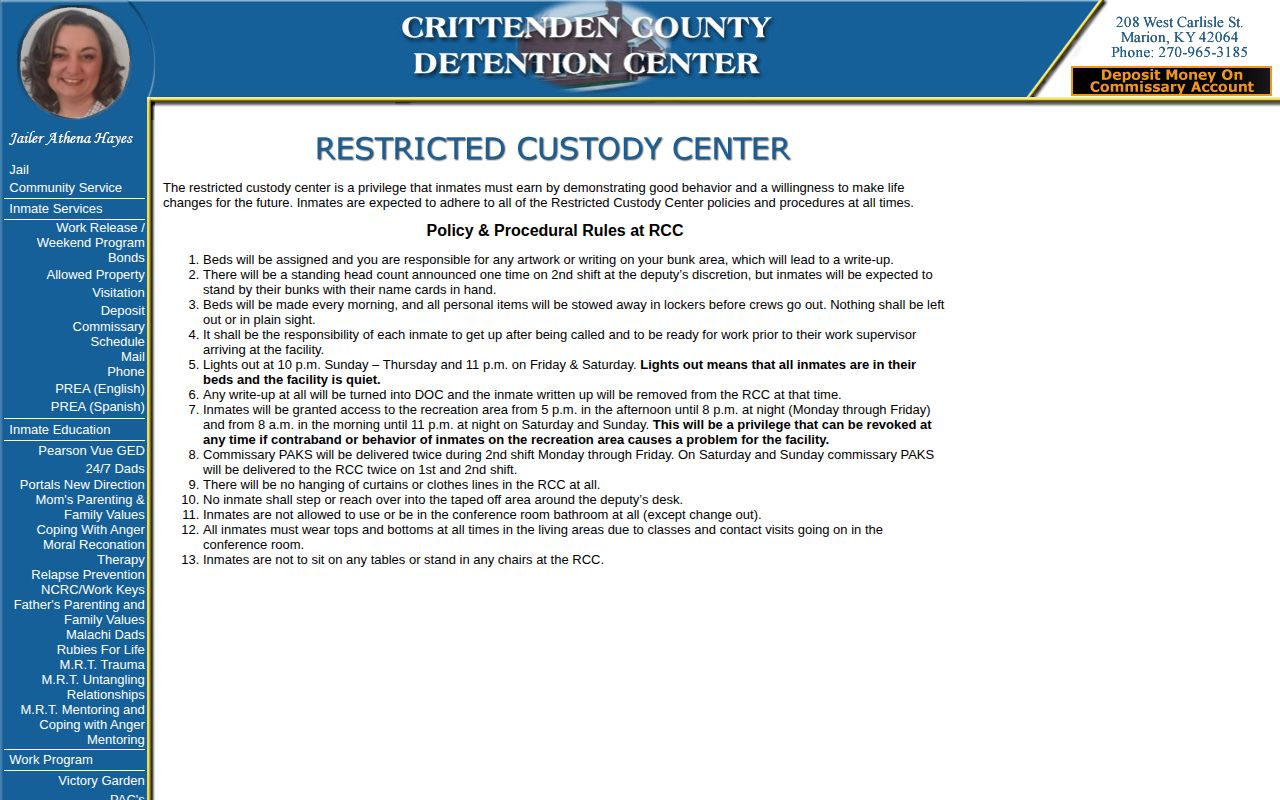
It documents the RCC identity and temporary community-custody context, which must be separated from final discharge.
Bond Processing and Physical Release
The detention center's older bond page says bonds could be paid through the Circuit Court Clerk on weekdays from 8 a.m. to 3:30 p.m., then at a jail lobby kiosk after hours. A dated July 24, 2023 local report said the detention center began processing cash bonds up to $9,850 around the clock. The sources do not fully match.
Call the jail or clerk before paying. Ask what bond type, amount, and channel are currently accepted. Payment does not clear a second case, another county hold, a federal request, or unfinished release work. The court docket supplies the order; the jail record supplies the actual custody event.
Note: Confirm that release has finished before traveling because no official final-release door, waiting area, fixed hours, or holiday schedule is published.
Temporary RCC Movement Is Not Discharge
The official work-release and weekender material uses release in a limited program sense. A work-release participant leaves for approved work and reports back. A weekender serves a 48-hour custody period, then repeats that cycle until the sentence is complete. The published $32 daily housing charge applies to that specific program and is paid in advance. It is not a general fee for leaving jail.
Final discharge needs a different record trail. For a state-tracked person, a KDOC Daily Releases PDF may list the release type and Crittenden location. KOOL may later show a community-supervision type and supervision dates. A court order or Parole Board action may supply the legal basis. These sources are stronger than seeing a participant on a road crew or at work.
Ask one precise question when calling: did the person leave on a temporary authorized activity, return to the RCC, transfer, or complete final release? Then request the existing entry that supports the answer. This keeps routine program movement from being mistaken for release into the community.